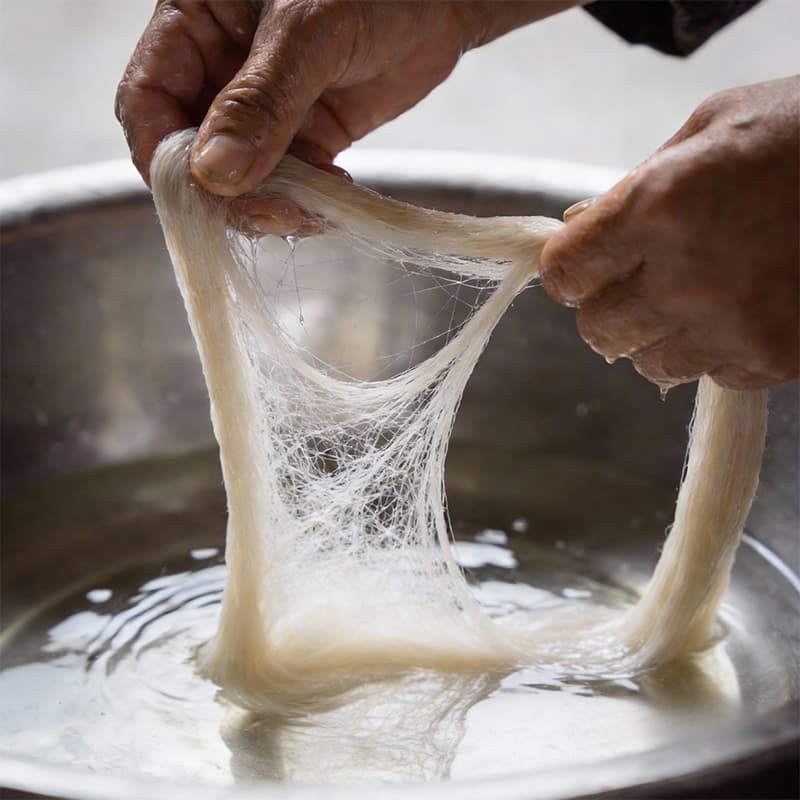
The cocoons, like tiny, damp pebbles, are submerged in basins of warm water. The heat is gentle, just enough to soften the natural gum (sericin) that holds the silk filament together. Then begins what is, to me, the most nerve-wracking step in the entire process: finding the end.
Imagine trying to find the starting point of a kilometer-long piece of hair, wound impossibly tight. The masters make it look like a parlor trick. A gentle swirl of the fingers in the water, a barely perceptible tug, and like magic, a wispy end appears, clinging to their skin. It feels less like technique and more like intuition—a silent conversation between the spinner and the cocoon.
Once found, the ends from several cocoons (usually 6-8) are gathered together and fed through a guide, beginning the ancient process known as “reeling” or “filature.” As the wheel turns, the cocoons bob and dance in the water, yielding their single, glorious thread. The sound is a soft, rhythmic hum. This is the moment the cocoon’s promise becomes tangible.
This is where patience is not a virtue, but a physical necessity. The hands of the reeler must be steady, her attention absolute. The thread is wet, delicate, and under tension. A moment of haste, a sudden movement, and it snaps. The entire process for that cocoon must begin again. There are no shortcuts. Modern machines exist, but they often break the long filaments, creating shorter staples of silk that lack the same strength and legendary smoothness.
Watching a master reeler work is hypnotic. Her eyes constantly scan the emerging thread, feeling for inconsistencies with a gaze as tactile as a touch. She is not just winding yarn; she is orchestrating unity, marrying multiple filaments into one stronger, more perfect thread. She is the conductor ensuring the symphony of the cocoons plays in harmony.
This step separates true silk from imitations. The length of the filament (“long-staple”) is what gives our silk its durability, its low-pilling surface, and that heavy, liquid drape. It’s also what makes it so forgiving to work with, why it takes dye so beautifully. Every second of calm, focused attention at this reel is woven into the character of the final fabric. It is the spinner’s dance—a slow, graceful, and utterly critical performance where the rhythm of care becomes part of the material itself.